Welcome back Vitalians! We’re excited to share our monthly update on everything happening across the VitaDAO ecosystem and the wider longevity community.
Let’s kick off with some big DeSci news - ARTAN Bio (the VitaDAO-backed company behind the VitaRNA IP-NFT) closes $1 Million Seed Round to Advance its tRNA Platform Toward Human Studies. For more details on this exciting development, check out our portfolio section below!
And the DeSci news doesn’t stop there. Decentralized Autonomous Organisations (DAOs) have now caught the attention of The White House in Science: A New Golden Age, a report to the President:
“Decentralized Autonomous Organizations, communities that pool resources and allocate them through collective governance, are beginning to fund scientific research directly without going through traditional institutional gatekeepers”.
Since VitaDAO’s genesis auction in 2021, Desci has gone from strength to strength, gaining increasing recognition as a model for funding and developing science. Major milestones have included a $500,000 USD investment from Pfizer Ventures and two articles in Nature Biotechnology: The community of the DAO and The potential of DAOs for funding and collaborative development in the life sciences.
This White House report is another striking sign of DeSci’s growing mainstream recognition, and of the increasing credibility of the funding model that VitaDAO, the movement’s flagship DAO, has helped pioneer.
Now let's check out what's been happening in VitaDAO's portfolio this month!
VitaDAO Portfolio Highlights
To date we have funded more than 30 projects. We are always looking out for more ground-breaking longevity drug discovery science to support, so email us at discovery@vitadao.com if you have, or know any researchers with, a great translational idea in need of funding!
Artan Bio Closes 1 Million Dollar Seed Round and Joins spARK Labs
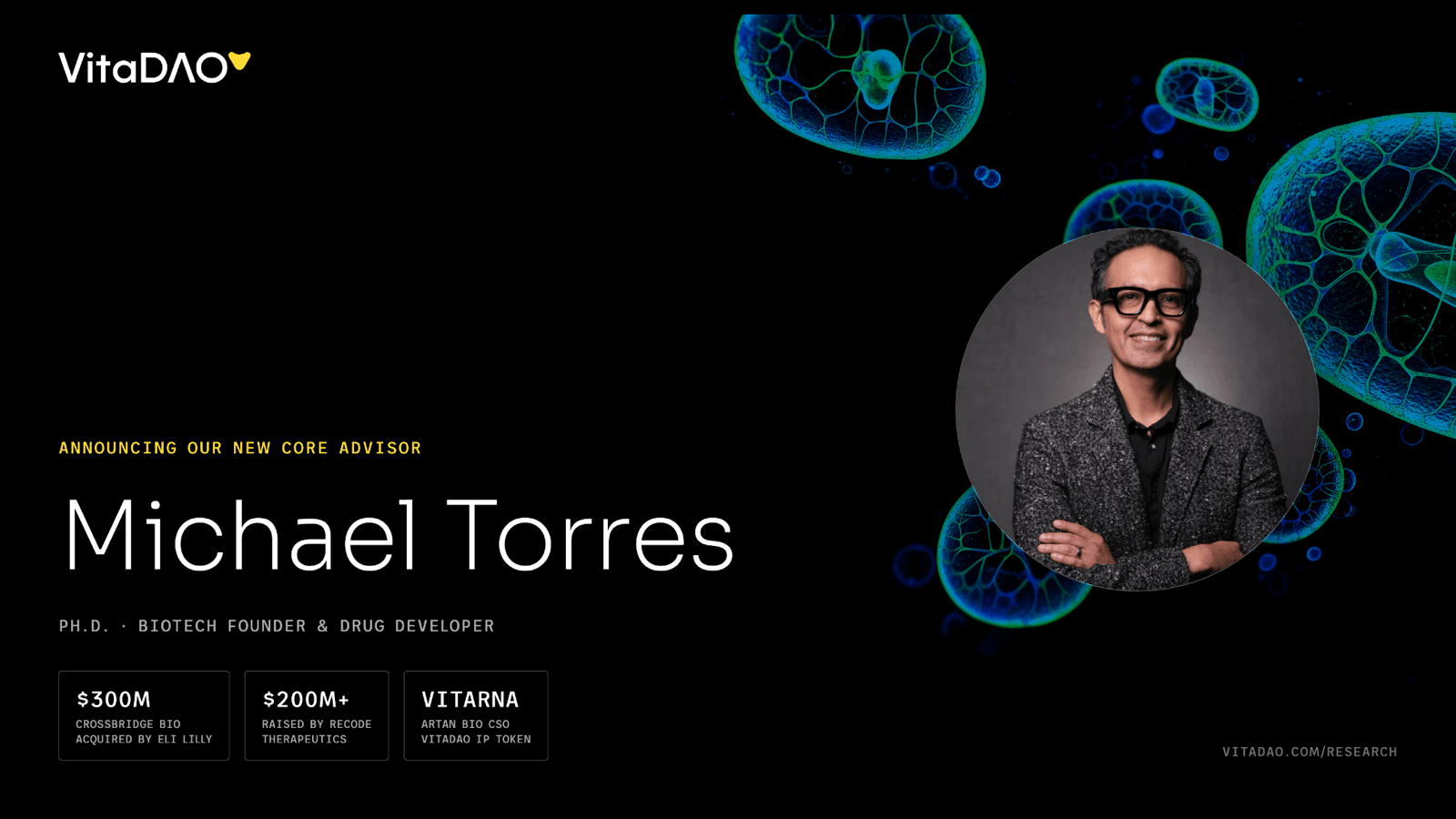
Artan Bio, the company behind VitaDAO's VITARNA intellectual property token, announced a $200,000 seed round raise on 4 June 2026 and confirmed its move into spARK Labs, the St. Petersburg innovation hub backed by ARK Invest. Then just weeks later, they announced that they had closed out a $1 million seed round, led by co-founder Michael Torres, fresh off the acquisition of his company CrossBridge Bio by Eli Lilly.
Artan Bio develops ARTAN-102, an engineered suppressor tRNA that corrects a particular type of nonsense mutation, which arises when a CGA arginine codon is mutated into a TGA stop codon. During protein translation, these premature stop codons can result in truncated, nonfunctional proteins. These mutations account for roughly 10% of all genetic diseases and could contribute to the biology of aging, which gives the platform broad potential reach across cancer and age-related decline. The mechanism is engineered for specificity, recognizing only the disease-causing nonsense codons so that healthy parts of the genome stay untouched.
With its earlier VitaDAO funding, the team completed in-cell validation, showing that ARTAN-102, delivered through a clinically proven AAV vector, restored protein levels in a cancer cell line. The team subsequently generated first in vivo data, demonstrating broad expression across multiple tissues with no adverse effects. Chief Scientific Officer Michael Torres described nonsense mutations as "a largely untapped vulnerability in aging and age-related disease”. Newly appointed CEO Brian Bodeman announced that this new investment will provide:
- The capital to advance three programs in parallel.
- Support for a commercial cosmetic product line, VitaBeauty, which will allow VITARNA partners, VitaDAO, to open up numerous token-specific value drivers.
- A clear path to FIH (First-in-Human) studies for the therapeutic program in the late-2027/early-2028 timeframe.
The financing keeps Artan Bio anchored to the decentralized science model, with the ARTAN IP-NFT fractionalized into the $VITARNA token that grants holders governance over research priorities and fund allocation.
Gero Reaches $34M in Equity Funding
Gero announced $17 million in new financing, bringing total equity funding to $34 million to advance its physics-first approach to aging drug discovery. The round arrived one week after the World Economic Forum named Gero a 2026 Technology Pioneer, part of a cohort of 100 early-stage startups from 23 countries. Investors in the financing included Melnichek Investments, alongside senior operators from the pharmaceutical and technology sectors.
Gero builds AI world models of human health trained on approximately 10 million curated longitudinal medical records, selected from more than 100 million and integrated with molecular, omics, and genetic data. The models separate reversible disease biology from deeper, long-timescale aging processes to identify "hub" targets, single mechanisms shared across multiple chronic diseases, and the platform pairs this discovery engine with ProtoBind-Diff, a generative model for small-molecule design directly from protein sequence. The company treats the pace of aging itself as the highest-leverage point of intervention, an argument CEO Peter Fedichev grounds in comparative biology: human mortality risk doubles roughly every eight years while a naked mole-rat's stays almost flat, which in his words means "that gap is a physics problem."
The financing rests on commercial validation as much as scientific framing. Gero's collaboration with Chugai Pharmaceutical, a member of the Roche Group, carries an upfront payment plus up to $250 million in milestones in addition to royalties, and the company previously conducted a research collaboration with Pfizer in 2023. The proceeds support preclinical development of Gero's pipeline and continued expansion of its pharmaceutical partnerships.
Rubedo's RLS-1496 Shows Efficacy in Actinic Keratosis with Minimal Irritation
Drug Discovery and Development covered preliminary Phase 1b/2a results for Rubedo Life Sciences' lead candidate on 2 June 2026, following the company's data release in late May. RLS-1496 is a selective modulator of glutathione peroxidase 4 (GPX4) under study in actinic keratosis, the precancerous skin patches caused by cumulative UV exposure. In the first 18 of 24 patients evaluated, the open-label trial showed a 46% reduction in AK lesion count at four weeks versus 11% on the untreated contralateral forearm, with no serious adverse events and no discontinuations tied to side effects.
The result matters because of the tolerability gap in current care. Standard field therapies such as 5-fluorouracil and imiquimod work through irritation, and CEO Frederick Beddingfield, a practicing dermatologist, notes that patients who get no irritation get no improvement, which drives poor real-world adherence: a 2023 study of 113 patients found nearly half non-adherent. RLS-1496 produced its efficacy signal with minimal local irritation, pointing to a distinct mechanism. GPX4 normally shields cells from ferroptosis, an iron-dependent form of programmed cell death; on Rubedo's model, brief inhibition tips senescent cells into ferroptosis and clears them, while cells that are merely aged read the same inhibition as a mild stress and mount an adaptive response.
Rubedo designed the trial to test skin rejuvenation as well, assessing whether the drug reverses the sun damage that gives rise to the lesions, with the skin-aging readout expected within weeks. A Phase 2b dose-ranging AK study begins in Q4 2026.
News and Media
We will now shift gears to highlight what has been happening in the wider longevity ecosystem.
ARPA-H launches $160 million effort to develop custom gene editing drugs
ARPA-H is investing up to $160 million in a major push to advance personalised gene-editing treatments for rare diseases. Through its new THRIVE program, the agency will support seven teams developing bespoke therapies for conditions spanning multiple organ systems, aiming to bring precision genetic medicines closer to patients.
The Wearable Showdown: Oura Ring 5 vs. Fitbit Air vs. Whoop MG vs. Apple Watch
Dubai launches authority for health longevity; Sheikh Hamdan announced as President
Dubai has launched a new Longevity Authority to help people live healthier, longer lives by supporting advances in medicine, biotechnology, and life sciences. Led by Crown Prince Sheikh Hamdan, the initiative aims to establish Dubai as a global hub for longevity innovation.
The forgotten organ that could predict how long you live
People with healthier thymuses—a small immune-system organ once thought to become largely irrelevant after childhood—lived longer and had substantially lower risks of heart disease, cancer, and death.
EU funding to solve aging
A new European funding call is putting serious public money behind longevity research, offering up to €4 million per project for biotechnology approaches to healthy ageing for a total of €30 million. For founders, scientists and early investors in the field, it signals that ageing biology is becoming a more formal funding priority in Europe.
Not all five-a-days are equal for heart health
Many people who eat enough fruit and veg may still miss out on flavanols, heart-healthy plant compounds found especially in foods like berries, apples, plums, broad beans, cherries and green tea. This study suggests that which fruit and veg you choose matters: adding flavanol-rich options could help lower cardiovascular disease risk.
The New Billionaire Bet Isn't AI - It's Longevity Biotech
Longevity biotech is attracting much larger investment, with companies reportedly raising $3.74 billion in Q1 2026, as wealthy tech investors and pharmaceutical partners look beyond AI toward biology. The field appears to be shifting from broad anti-ageing ideas toward drug programmes with clearer clinical and regulatory paths.
Tech titans are hacking their bodies for a longer life: is there science behind their methods?
This article looks at the growing trend of wealthy tech figures and influencers experimenting with intensive “longevity” routines to try to extend life. It questions how much of this is backed by solid science, distinguishing plausible health practices from more speculative biohacking claims.
The quest for immortality: How science is trying to end ageing
Longevity research has transformed from ancient myths, such as Emperor Qin Shi Huang's search for an elixir of immortality, into a multi-billion-dollar scientific endeavour backed by tech billionaires and governments around the world.
NeuroAge Therapeutics Launches Younger 2027
NeuroAge Therapeutics announced Younger 2027, a six-month biological aging contest in which competitors are measured on a clinical-grade aging panel and retested six months later.
Clinical Trials
Life Biosciences made medical history by dosing the first human with an experimental cellular rejuvenation drug called ER-100. This is the first time in-vivo partial epigenetic reprogramming—designed to reverse cellular aging—has been tested in a patient. The Phase 1 clinical trial is actively testing the drug on patients with open-angle glaucoma and NAION.
First human trial targets aging immune cells for healthier immunity
A first-in-human clinical trial will test a therapy designed to rejuvenate aging immune cells, with the aim of restoring a more youthful and effective immune system. If successful, the approach could eventually help treat age-related diseases such as cancer, HIV, and dementia.
China launches first large-scale stem cell antiaging trial
A large clinical trial involving 2,000 participants in China will investigate whether stem cell therapy can help people stay healthier and maintain physical function as they age. If successful, it could provide important evidence for one of the most closely watched approaches in regenerative medicine.
Industry
NewLimit raises $435M led by Founders Fund to bring longevity medicines to human trials
Longevity startup NewLimit has raised $435 million to advance its first anti-aging medicine into human clinical trials next year. The treatment is designed to reverse signs of aging in cells, following promising results showing it could rejuvenate old human liver cells in the laboratory.
Rejuvenate Bio Announces $6 Million Financing and Strategic R&D Collaboration with Merck Animal Health
Rejuvenate Bio has raised $6 million to develop gene therapies that target chronic and age-related diseases in companion animals. The company has also formed a research partnership with Merck Animal Health to accelerate the development of new gene therapies for veterinary medicine.
ADA: Lilly pulls back curtain on impressive triple-G efficacy in patients with obesity, diabetes
Eli Lilly has reported new evidence that its experimental weight-loss drug retatrutide could help a broad range of people with obesity, including those with type 2 diabetes. The drug belongs to a new generation of therapies that target three metabolic pathways simultaneously, with the aim of delivering greater weight loss than current treatments.
Podcasts
The Matt Kaeberlein podcast
- The $1 Billion Bet on Human Longevity | Steve Austad
- The Clinical Trials That Could Transform Longevity Medicine
- Is Rapamycin Dead?
The Sanz Science Experience
Mitophagy Reactivation Reverses Cellular Ageing
BSRAgeing
Exercise as Treatment for Falls Prevention
The BioShift Podcast
Building for a Pharma Exit: Michael Torres on Success — this episode discusses Michael Torres’s sale of CrossBridge Bio to Eli Lilly and the lessons behind it, especially the importance of relationships, timing and spotting the right opportunity. It also looks at the growing potential of longevity medicines and what Torres plans to build next, including the VitaDAO-backed gene therapy project VitaRNA!
Preprint Corner — in collaboration with The Longevist

The Longevist is a preprint overlay journal spotlighting the most promising longevity research. The journal is currently paused as we build an automated curation agent - the Longevist AI Agent (LAIA). To stay updated, sign up to our newsletter and follow us on X.
Declines in mRNA synthesis set the rate of organismal aging
As animals age, many of their cells produce less messenger RNA, limiting how much protein they can make and weakening normal function. In worms, this decline appears to be driven by falling levels of RNA polymerase II, and slowing that decline extended both healthy life and lifespan, suggesting that aging may partly arise from a developmental imbalance established early in life.
On an Integrated Theory of Mortality: An Information-to-Order Framework
The authors propose that aging is driven by the gradual corruption of DNA and RNA, which makes cells increasingly less able to produce and maintain the proteins and processes needed for life. They argue that protecting this biological information could slow aging and reduce age-related disease, although this is a theoretical model rather than established evidence.
Predicting Mouse Lifespan-Extending Chemical Compounds with Machine Learning
Researchers trained machine-learning models on mouse lifespan data to predict drugs that might extend healthy life, finding that models based on drug targets performed best. The approach highlighted several promising drug classes, and 6 of 22 predicted compounds extended lifespan in worms, suggesting this could help prioritise future longevity drug candidates.
The aging genome exhibits organized vulnerability to somatic mutations
This study suggests that age-related DNA mutations are not scattered randomly across the genome: the most important, highly connected genes appear to be relatively protected. The implication is that ageing may depend less on the total number of mutations and more on whether damage hits key “control points” in the cell.
Published Literature Hot Picks
Our paper of the month award has to go to:
Reversal of protein chemical aging by enzymatic deglycation
Advanced glycation end products (AGEs) are proteins or lipids that become glycated after exposure to sugars which are known to accumulate with age.
Researchers engineered an enzyme called CMLase that can remove AGEs from proteins and restore the original amino acid. It worked in laboratory proteins and tissue from older people, suggesting that some molecular damage once considered permanent may eventually be repairable, enabling scientists to causally test if AGEs are a driver or simply a consequence of the ageing process.
Outro
We hope you enjoyed this month’s update on the latest happenings at VitaDAO and across the wider community. Stay tuned for more on what we’ve been working on in next month’s edition.